Wednesday, 27 November 2013

What happened to the Widow Anne Gleeson?

On Wed Oct 17th 2012, Dad and I drove down to Killoscully, stopped in Moneygall at the Obama Cafe for lunch, took a photo with Barack, and then continued on to Killoscully where we met John "Rocky" McGrath, who had sent us John Ryan’s book “Playing with the Hill” in the post. This book documents the early days of Martin M Gleeson who founded the Ballinahinch Killoscully GAA Club in 1886 before heading over to Baltinglass. Rocky was very generous with his time and drove us around the area, introducing us to various local residents and showing us where Anne Gleeson lived before and after her marriage to Paddy Ryan Soldier.

Summary of Family History
The 1865 church marriage record of my great great grandparents indicates that John Gleeson was living in Shallee but there is no record of the address of Anne Gleeson. However, they were married in Ballinahinch, presumably the bride’s parish. All the children were born in Shallee, Longstone, or Killoscully (neighbouring townlands).

After John died in 1885, Martin founded the GAA Club by 1886 (possibly 1884 in Killoscully) and then left for Baltinglass in June 1888 (the date of his first diary). No year is known for the emigration of the other siblings, but in 1885 they would have been the following ages: Martin 19, Catherine 17, Bridget 14, Timothy 12, Winifred 8, Nora 6, Paddy ~4, and Mary 1. In the 1901 Census, Mary is living with Martin in Stratford-on-Slaney, and there is a Patrick Gleeson aged 21 living with Anne Gleeson and Paddy Ryan Soldier in Ballyhourigan. Presumably the other siblings had emigrated at that point.

In 1895, widow Anne Gleeson married Paddy Ryan Soldier who had previously been married to Catherine Hayes and had 5 young children of his own – Martin 13, Mary 10, Thomas 8, Patrick 6, and Annie or Hannie 4. On their church marriage record, Paddy’s address is given as Ballyhourigan and Anne’s as Barnabaun. In his earlier marriage record to Catherine Hayes, Paddy’s father is named as Martin Ryan (this is in keeping with the Valuation Office Cancelled Books from 1886 onwards – see below). It seems that after the death of her first husband, Anne Gleeson moved from “Shallee” to Barnabaun, but we don’t know when.

Townlands and Families
Griffiths Valuation was conducted in 1850 in the Civil Parish of Killoscully, which incorporates various townlands including the various Shallee townlands (Shallee Coughlan, Shallee White, Shallee Upper and Lower) as well as Longstone, Ballyhourigan, Barnabaun, and Maryglen (see map below). In Griffith’s Primary Valuation, the main families in Maryglen are the Ryan’s (Ryan Dick’s and Ryan Johnnies, according to Rocky), in Ballyhourigan are the Mara’s (later O’Mara’s), and in Barnabaun are the Mara’s. In the subsequent Cancelled Books, Paddy Ryan Soldier’s cottage appears in Ballyhourigan suggesting it was built between 1850 and 1886. We haven’t examined the Cancelled Books for Barnabaun or Maryglen as yet.


Townlands around Shallee
In both Barnabaun and Ballyhourigan, large tracts of land were owned by the local landed gentry, the Bloomfields (and later the Kingscote’s), whose seat was Ciamaltha House in Gaurenbeg beside Maryglen. Rocky showed it to us from the car as we drove down to the widow Anne Gleeson’s old house. Apparently it was built by Lord Bloomfield in the late 1830’s and passed to his daughter Harriott who married Thomas Henry Kingscote of Gloucestershire in 1833. In the early 1900’s it was occupied by her grandson, Col. Randolph Kingscote, until 1922. Rocky pointed out a row of sandstone cottages that Lady Bloomfield built for her workers – she appears to have been quite progressive.

It may be that our John Gleeson was a “labourer’ on the Bloomfield/Kingscote estate and the Estate Papers (if they exist) might contain some info on him. It could be very helpful to view these as they may contain some useful additional information.


The House of Widow Anne Gleeson in Barnabaun
Rocky first took us to the house where Martin is supposed to have lived. John Ryan states in his book: "Martin Gleeson lived a short distance beyond Maunsell's cottage in Maryglen. His mother, who was widowed, later married Paddy Ryan (Soldier). Through this marriage he would be related to the O'Meara's of Bearnabawn." The house/cottage is now owned by a very industrious young woman from Belgium and her husband. The two of them have about an acre of land at the back which they have fashioned into a beautiful terraced garden (clearly visible on Google Maps) working mainly with their own hands! It is a delightful 2-storey white-washed cottage with red window frames and a slate roof.

Widow Anne Gleeson's cottage
(she probably lived here some time between 1885 and 1895)

The present owner was kind enough to exchange a few words with us and she told us that she and her husband had lived there for 10 years. She did not know much about the previous owners but apparently it was bought by Coillte (from whom they had bought it) so they may have records in their Limerick office (or the Land Registry Office). Coillte had boarded it up (bricked up the windows and put in a steel door and corrugated iron roof) because people used to steal the chainsaws. The roof used to have big stone slates before that, said Rocky. She recalled that there was a Mara or an O’Mara there previously but that might have been before the Gleeson’s. She said the name Gleeson Rabbit rang a bell. They had looked up OSI maps and these had a list of the people who had paid rent previously.

In Griffiths Valuation (1850 in Killoscully parish), there are 2 houses in Barnabaun, both owned by Mara’s (Denis & Dermott) and valued at £1 7s – these would have been substantial houses. From the 1880’s map it would appear that there are still only 2 dwellings in Barnabaun. By going thru the Valuation Office Cancelled Books for this townland, it will be possible to see if and when the widowed Anne Gleeson moved in there. The period of interest is 1885 to 1895 (from the death of her husband to her remarriage). 

The House of Paddy Ryan Soldier – “Maunsell’s Cottage”
When she remarried to Paddy Ryan (Soldier), she moved up the road to his house in Ballyhourigan – the so-called Maunsell’s Cottage (below, from Google). In Griffith’s, it would appear this was not built at the time of the Primary Valuation in 1850 but was by 1886. The Cancelled Books from the Valuation Office (which I have from 1886 to 1968) show that Martin Ryan owned “House, Offices & Land” valued at £1 5s on site 4a (this valuation never changed, all the way up to 1968 – see below). This passed to Patrick Ryan between 1899 and 1902 who appears to have bought it in 1915 via LAP (Land Act Purchase). He is actually named as Paddy Ryan Soldier in an entry for 1924. Then in 1935 it passed to Martin Ryan, and in 1949 to Denis Maunsell (and hence, presumably, the name Maunsell’s Cottage).

Maunsell's Cottage today
The only other building in Ballyhourigan (a substantial dwelling, valued at £8 4s in the Primary Valuation and then downvalued to £6 13s by the subcommissioners on appeal – see below) was owned by Thadeus Mara (?related to the other Mara’s of Barnabaun). By 1886, this was valued at £5, and had passed to Johanna Mara who bought it via LAP in 1916 and remained there until 1924 when it passed to Tim O’Mara (note gaelicisation of name). Apparently the Mara’s of Ballyhourigan sold their farm to a man called Flaherty, and then the Land Commission took it over. Over the years, the Mara’s house fell into disrepair and was eventually flattened as it didn’t have a roof on it.

Paddy Ryan Soldier’s family
Rocky took us to meet a very sprightly Nonnie Healy and her equally sprightly new dog Oscar, a cocker spaniel. Before her marriage, Nonnie was Ryan Stack (a Ryan Stack was the head gardener to the local landed gentry, the Kingscote’s of Garaunbeg). She was also very good friends with Mary Doogue (nee Ryan). Mary’s siblings included Bree, Winnie, and several boys who all worked in Guinesses. There is a connection with botany.

Nonnie also told us that she didn’t know when Paddy Ryan Soldier died; but his eldest son Martin married a Kilkenny woman; his son Paddy never married; and his youngest daughter Hannah got married and lived over in Dollas. The Ryans are buried in Killoscully churchyard because Nonnie remembers that Mary put down a kind of a marker in the graveyard some years ago.

I later found the death notice of Mary Doogue on the Irish Times website. Sadly she passed away in 2005 and was survived by her husband Eamonn, sisters Bree (Hourihane) and Winnie (Hogan), brother Michael, daughter Marian (Coffey) and son Declan – the latter is a botanist and I was able to make email contact with him. He said he would ask his uncle and aunts if they remembered their step-grandmother Anne Ryan (nee Gleeson). The questions I posed are below. If anyone else has any information and can attempt to answer any of them that would be a great help:
  • Anne Gleeson married Paddy Ryan Soldier - Soldier was the family nickname to differentiate one Ryan family from another. But does anyone know the nickname of Anne Gleeson's family? and what about that of her first husband John Gleeson? does the nickname Rabbit or Thaddy or McEvaddy ring any bells? How about Kitt or Cooper or Helper?
  • Did Paddy Ryan have any other children apart from the 5 mentioned above? Did Paddy Ryan have any brothers and sisters? Perhaps a Daniel, Johanna, or Anne?
  • We have the 1895 church marriage record of Paddy Ryan and Anne Gleeson but never found the Civil Registration Record - des anyone have it? it would contain the names of Anne's parents. Des anyone know who they are? Des anyone know if Anne had any brothers and sisters?
  • Does anyone know where Anne is buried? Does she have a headstone? Does anyone know where her first husband John Gleeson is / or might be buried (ie which graveyard)?
  • Did anyone ever receive any correspondence from any of the children from Anne's first marriage? does anyone know what happened to any of the children from Anne's first marriage? did anyone ever hear of Ruby Kathleen Gleeson?
  • does anyone have any old photos of Anne or her children from her first marriage?


Tuesday, 6 August 2013

The Walsh's of Cushina (1)

Yesterday, my nephew and I went in search of our Walsh ancestors from Cushina. My impromptu adventure with Oisin was entirely opportunistic and boiled down to one simple and undeniable fact - I happened to find myself in Laois. As you do. And knowing that I had ancestors who had lived relatively nearby, I decided to take a chance and go and look for them. Simple as that.

Ford's Model T
We had spent the day at the Annual Stradbally Steam Rally with Oisin's dad Philip, brother Luka, and Jose and Maria, a couple visiting from Spain with their two children, Noah and Rodrigo. Fabulous steam-driven engines paraded around the paddock, intermittently emanating horrendous screeching whistles, accompanied by emphysema-inducing billows of  dark fuming smoke. There was a vintage car rally with vehicles varying from Ford's Model T to something out of The Dukes of Hazzard. And the dodgems. And the Bouncy Castle. And the Port-A-Loos. All the Fun of the Fair. The Tractor Pulling Competition was my favourite (I'm not sure if it was a competition or a demonstration - no one seemed to be winning) and I would definitely go back again to see that alone! After the fair ended (or rather, after it was abundantly clear that certain children - who shall remain nameless - had had more than enough and were only minutes away from disembowelling each other), Oisin and I broke away from the main group and headed north from Stradbally to Portarlington and from there on to Cushina. In so doing we managed to divide and conquer, effectively averting World War III in Philip's car on the way home. Phew!

Cushina is in county Offaly (King's County of old) but lies within 1 kilometre of Co. Kildare (which is to the southeast) and 2 km of Co. Laois (ex-Queen's County, which lies due south of it). Townlands and various other geopolitical divisions can span all these county lines, potentially creating problems when trying to isolate in which particular division one's elusive ancestors resided.


The Walsh's had moved to Cushina some time around 1860. They don't appear in Griffiths Valuation (which for Cushina was published in 1853), so in order to locate their homestead we had to rely on the 1901 and 1911 census entries and work backwards using the Cancelled Books from the Valuation Office. I'll speak more of these in a subsequent post. So one goal for the trip was to try to locate the ancestral homestead.

James Walsh was the pater familias. He married Ellen McEvoy on 1st Feb 1861 in the district of Stradbally in Co. Laois. Their first child was born in Cushina in 1864, as were their subsequent children. The farm passed to their son Garrett and from him to his daughters, Eileen and Mary, who eventually sold the land to Bord na Mona.

With a common name like Walsh, and the lack of distinguishing forenames, it has not been possible to pinpoint the likely death records for James and Ellen using the Civil Registration Death indices. Garrett however (having a relatively rare forename) has been tracked down to 1937. I'm assuming that he was buried somewhere near Cushina, and that there may be a family plot and that his parents James and Ellen are possibly buried in the same place. That being the case, a gravestone (should one exist) would potentially offer additional information that would help us expand an important part of the Walsh family tree. In short, find Garrett, and we'll probably find his parents, and possibly a whole lot more. So, goal number two for the trip was to find the family grave.

One of the advantages of actually visiting where your ancestors lived and simply driving around the place, is that you can screech to a halt, slam the car into reverse, and waylay locals who are painting their gates.
"You wouldn't happen to know where the Walsh's lived?"
"Oh, there's some just down the road a bit."
"I'm talking about 50 years ago or so?"
"Oh ... hmmm (long pause) ... hmmm (longer pause) ... hmmm (will it never end?) ..."
"So you don't know?"
"No."
"Well thanks anyway. Good luck with the gate."
Bracknagh cemetery
But we did get directions to the local graveyard. About 2 miles east, in Bracknagh. The gaelic version of the name is Breachanach, which is probably related to Breathnach, which is the gaelic version of the surname Walsh. So we are definitely in Walsh country here. We toured the graveyard, well kept by the local community with obvious pride, and found one Walsh but not one of ours. A dead end. A nice lady suggested we try the cemetery in Walsh Island, and if they weren't there, she said, "they're probably in Portarlington".

Back into the car, back in the direction from whence we came, past the painted gate, right turn onto Pike Road, and no further than 500 yards down the road than we spy another local. Slam, reverse, waylay.
"You wouldn't know where Garrett Walsh used to live, by any chance?"
"Sure. That house right there. I remember my father taking me to see him as a child."
And there it was. Down the road about 300 yards. You could see the farm buildings above the trees. We chatted for a few minutes with this local gent (who must have been close to 80), thanked him profusely for his help, wished him good luck with his gate (yes, he was painting it too), and headed up the road.

There is no substitute for local knowledge. And the older the person, the more the knowledge. I usually end up stalking old-looking people on my trips. I follow them into shops, or "accidentally" bump into them in graveyards. Any excuse to strike up a conversation. A conversation that always ends with "have you seen my ancestor?"

And more often than not they have! 

Walsh Family Homestead
Rounding a slight bend, a hedge and trees obscuring our line of sight, the Walsh family homestead emerged into view. A simple, but rather long, one-storey cottage. With a porch. And a large front garden. Unadorned and rather plain. In fact, it looked like two cottages joined together. It may have been a single cottage to start with and had the equivalent of another one added later. The Cancelled Book records may throw some light on this. And behind it, the farm buildings. Large barns and storage sheds with corrugated rooves.

Opposite the house, two white horses stood by a gate, bemused. And beside them, a railway track and a level crossing. But no ordinary railway track. This one was much smaller and a sign on the gate indicated that it was owned by Bord na Mona. This was the railway that transported the turf and the peat from the bogs that surrounded the area. Whether it was still in use or not was difficult to say. It looked like it hadn't been used in a while.


Two of the great things about the street view feature on Google Maps is that you can take a pre-emptive virtual trip before undertaking a real one, and you can retrace your steps afterwards. Travelling virtually back along our route that night when I got home, it was easy to recognise the houses along the road, the places we had stopped to ask for directions, and the Walsh homestead itself. Switching to satellite view, the railway track beside the farm was plainly visible, and the house itself easily identifiable. Another important landmark revealed by the satellite photo was the River Cushina which ran in a broad quarter-circle to the north of the property. This will prove invaluable when comparing the present day map with older ones.

Present Day Map - homestead marked by blue marker
Valuation Office OS Map - probably early 1880's: homestead marked by letter a, beneath 4B

So already the trip was a success - we had found the ancestral homestead. Occupied by the Walsh family from the early 1860's. A satisfying conclusion to an impromptu trip, even if nothing else was to be discovered.

An old turf train engine
But we still had to get to Walsh Island and check out the second cemetery. So, back in the car, last leg of the journey (we were getting hungry now), and off to Walsh Island. We passed an old turf train engine on the way, mounted on a set of rails, on a little green in a curve on the road, exhibited, suggesting that these trains are no longer in use.

The graveyard in Walsh Island was another example of a meticulously kept cemetery. It's great to see communities taking such pride in their local heritage. There were quite a few Walsh's therein but no names that I recognised and no sign of Garrett or his parents. So, time to call it quits. The family plot, if there was one, was probably in the cemetery in Portarlington. A job for another day.

Walsh Island cemetery
So it was back home with Oisin, passing gate-painters on the way (was it a National Holiday or some Gate-Painting Festival, I ruminated; well you never know - they pull tractors), stopping for burger and chips along the way. Oh how Oisin does love his uncle - who else would take him to graveyards, and treat him with burgers and chips, and he only six? I ask you.

So what have we achieved? Locating the family homestead will allow us to go back to the Valuation Office Cancelled Books and use them to trace the ownership of the house back to the time of Griffiths Valuation (1853), thus ascertaining who the previous owners were. We still don't know why the Walsh's moved into this house, where they came from, or who lived there beforehand. And we don't know who James' and Ellen's parents were. Perhaps being able to trace the previous owners in 1853 will give us some clues. Secondly, ruling out two of the local graveyards as probable locations for the family plot points to Portarlington cemetery as the most likely location. A visit here might reveal a gravestone with information that will help us sift through all the various online records that could be relevant to our Walsh ancestors.

New records, however, are coming online all the time, and in writing this blog I have happened upon the death record for James Walsh! We knew that he probably died some time between 1876 (the birth of his last child) and the 1901 census (from which he is absent), but just today, hot off the press, I found his death record in the Calendar of Wills and Administrations for Ireland


From this it is clear that he died on 23rd Oct 1897. Consequently, of the several previous possibilities for his death record among the Civil Registration Indices, there is only one that matches the above new information, and that is the entry for Oct-Dec 1897 in Tullamore, which estimates his birth year as 1832. I will order this death cert from the GRO (General Registry Office) in due course. And having a definite date for his passing means that we can look for an obituary in the local paper, which may contain details of his relatives.

So, all in all, a very successful trip!


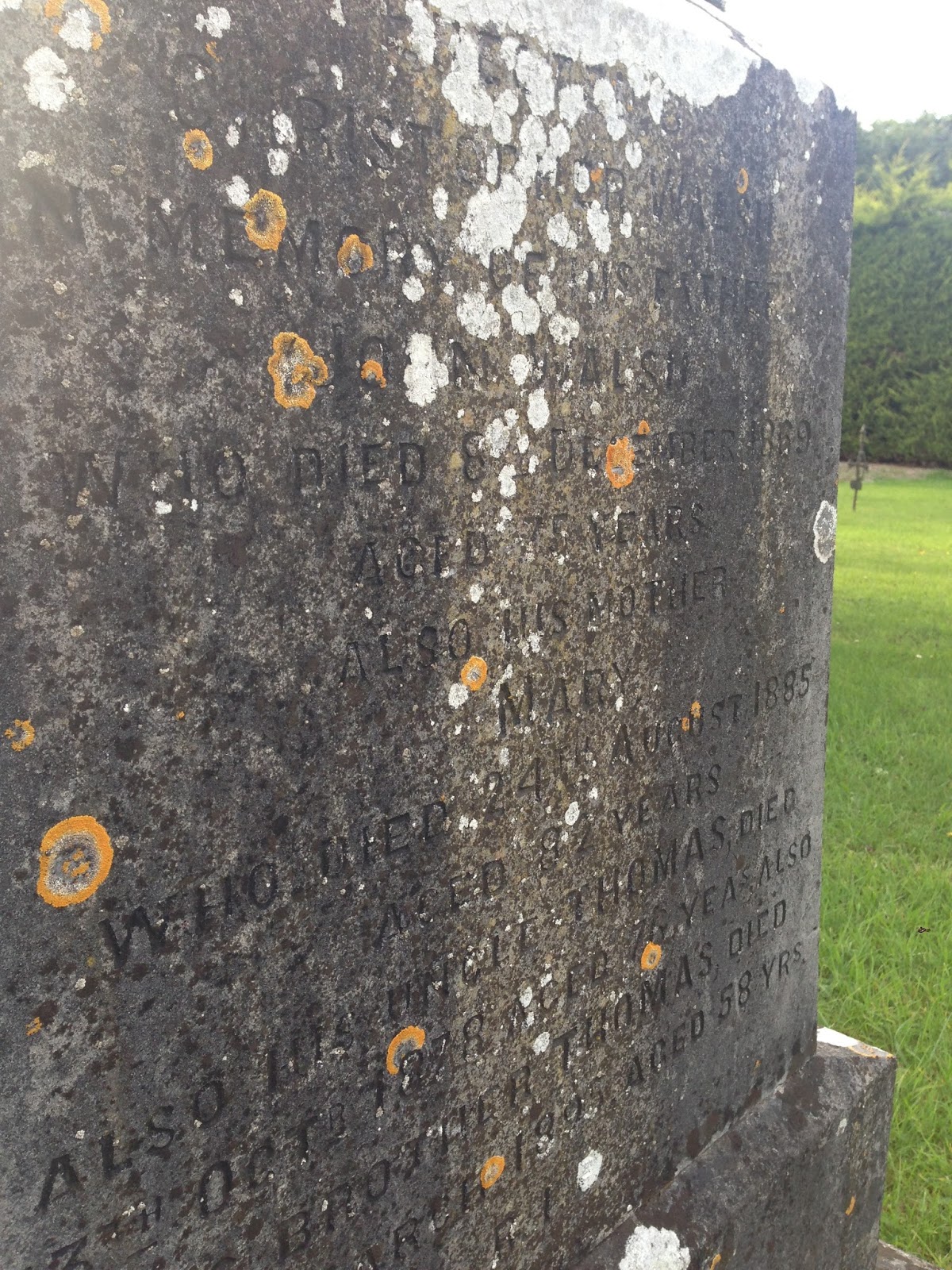
Photos of Walsh headstones from nearby cemeteries
(no known relationship exists between these people 
and our particular clan ... as far as we know)

Walsh - Bracknagh cemetery


Walsh - Walsh Island Cemetery

Walsh - Walsh Island Cemetery

Walsh - Walsh Island Cemetery

Walsh - Walsh Island Cemetery

Walsh - Walsh Island Cemetery

Walsh - Walsh Island Cemetery